
Category Archives: Uncategorized

A Bouquet of Memories by Circespeaks

No Disinterested Act

No disinterested act is possible. No matter what we do, no matter how altruistic our actions may appear, we have our own best interests at heart. We can’t help it.

The return we receive for the time, effort, love, resources–financial and other–we invest to help others is sometimes obvious, and at other times veiled or opaque. It is obvious why we go to work and to school. We receive a paycheck, a degree, and possibly elevated social standing, as well as increased self-esteem, in return.

The same, minus the paycheck, is true of volunteer work. Volunteer work or charitable work is a particularly controversial subject. In order to volunteer to help others, we must live in a stratified society, where some people do not have the basics. Everyone should have health care, housing, food, access to a good education, employment opportunities, and–unless a violent criminal–freedom to live unincarcerated. Since this is not the case, a crazy quilt patchwork of volunteers and volunteer organizations attempts to help those who are deprived of life’s basic necessities.

The disparity between those who have, and those who do not, continues to grow in the United States. Thus, to be in a position to provide charity to others, we must have, somewhere along the line profited by inequality. My grandfather was wealthy, so my father was born wealthy. Not extraordinarily wealthy by any means, but wealthy enough to attend a university, and thus to enlist in the Korean War and immediately be granted the rank of captain, and a pleasant service in New Mexico. He did not go to Korea and freeze to death, or I would not be here today. Eventually, with some help from his parents and the G.I. Bill, my parents bought a home in a safe place with good schools. We were financially strapped–Thomas’s English Muffins were the basis of many a meal–but we were not hungry and lived in a safe environment.

In many another country we would now be comfortable and saving for retirement. Instead, we eke out tuition payments to an out-of-state university. We have not put a dime into retirement savings in six years. I have placed my bet, instead, on my sons: they should be able to attend college and graduate debt-free. If not, they would be the first generation burdened by student loan debt at an unreasonable interest rate. The government profits doubly by our actions. No income is sheltered from taxes in our retirement account, and we are providing society with two graduates educated in the sciences. (Not quite yet, since one son started his university education less than a month ago!) We just hope to die young. No, I am not kidding. But it is natural, and not noble, for people to put their children’s interests ahead of their own.

Those who work to promote social justice, to convert others to their religion, to protect the environment, to risk their lives protecting the lives of others, to care for their children or aging parents have objectives for the society in which they live. They also have the resources to put their beliefs into action. One cannot participate in unpaid work when bills are unmet. The preponderance of women doing unpaid work in our schools– to cite one possibly controversial example — arguably does disservice to women, while, at the same time, promoting the interests of their children, and possibly their own social standing in their community. These women are, however, not amassing social security, pension, retirement benefits or job experience which they may later need. Meanwhile, their male peers are working in the traditional economic sphere, in which such benefits are collected and amassed. Younger and middle-aged men working in the sphere of economic power are able to capitalize on their work in many concrete ways, while younger and middle-aged women continue to work in the highly rewarding, but unpaid, volunteer sector, are not.

Are Bill and Melinda Gates saints? Certainly they are preferable to Donald Trump, who is clownish in his bombast and self-interest. They are, most would agree, “good people,” doing more for others than is strictly necessary. But having amassed their fortune, why wouldn’t they want their children to grow to adulthood in a world plagued by fewer diseases, and in which more people are grateful to the efforts of Americans?

I am now on my way to pick vegetables at our local, organic CSA (Community Supported Agriculture) Farm. Not so short-sighted as to want to consume organic produce only for the sake of my own health–I do breathe the same air, drink the same water, and walk on the same earth as all other living creatures–it is more for the precious earth, to spend time outdoors, to protest all things Monsanto, and to help a small, organic farm to succeed even in hard times that I go.

And since I have my own small, organic garden, I go for inspiration. But more than inspiration–I will stick with easy crops and let the farm family struggle with managing the difficult ones–I go to be close to the earth and the food. I also go to make a small stand on the issue of division of labor. Not wanting to deprive workers of their jobs, I still want to participate, side-by-side, at getting down in the dirt. And, yes, unless I must do this in order to feed my family, and unless I must do this five-to-seven days a week, it is really only a symbolic act. Symbolic acts, as sociologist Pierre Bourdieu pointed out, perpetuate and reify the existing social order. So maybe I do more harm than good. I have not thrown in my lot with farmers or farm-workers, but I have a son who thinks he would like to be a farmer. My son’s interest in sustainable agriculture is a recent development, subject to change. We have participated in the same CSA farm for many years, both the good and the bad. This has been helpful to the farmer, but it has not been a disinterested act. I fear for the future of the earth, the health of my own children, all children, and future generations if the agribusiness industry continues to have its way with us.
When I make a bi-monthly pilgrimage into local fields, in good weather and bad, I am closer to the earth I love to smell and touch, and also make a small, quiet political statement, and an attempt not to become “Comfortably Numb” (Pink Floyd, 1979.)

The tomatoes we eat, and, more than anything, the flowers we pick, feed my soul. Today, together with other family members, I visited our family memorial garden. The pink cosmos, purple verbena, feathery yellow and red celosia, and globe amaranth, red, pink, and purple, now decorate the site where my father’s ashes are spread. Carefully selecting each flower in the field, sharing them with family members, and gently placing them where my father’s physical remains lie, was a powerful, loving ritual.

20130909-140225.jpg
A Bouquet of Memories by Circespeaks
I’m Not a Barbie Girl: Getting Over Cute

Not long ago I was at a party. Having arrived hours after many of the other guests, I didn’t get much food, but I also didn’t have the pleasure of drinking quite as many Keystone Lights as the others did. Why anyone would drink Keystone Light is a question this beer snob–though that may be an oxymoron–is still ruminating over. Beer pong is the obvious answer, but it is cultural, too.

The volleyball was fun! The company was interesting and intelligent,though progressively less so as the evening went on. Or not so much less intelligent, as more intense andrepetitious. Everyone had a project for me to do, or offered sincere, lengthy solutions to problems that weren’t really on the table. Only later did I realize that I felt interviewed, scrutinized, cross-examined… by a group of rising third-year law students. Tenacity and problem-solving is in their blood–along with a lot of KeyStone Light.

After listening to a long, semi-articulate dissertation on an upcoming project on which we might collaborate–wishing I could be set free to find the nearest bathroom–but not leaving because I was afraid the person holding forth might plummet from a precarious perch headfirst onto the floor, I began to become disenchanted. Another persistent person wished to offer help and provide contacts that would smooth my scholarly path. She had a British accent, so managed to sound scholarly herself. I regretted handing over a business card, but need not have feared: I have never heard from her or her cadre of helpers since that evening. She wasn’t in bad shape, just overly persistent and enthusiastic, and possibly realized that I had been less so when she awoke the next morning.

No, it was not a chair that tipped me into a phase of abstinence, but a well-meant comment by another party goer: “Look at Circe in her little shorts. She looks so cute.” Maybe “cute” was not the exact language used (I am afraid of cross-examination!) but for the purposes of this post, and to save myself additional embarrassment, we’ll say it was.

Despite my comparative abstemiousness that evening, I wasn’t as sensitive to the implications of that innocent, well-intentioned comment until the next day. It was then that I thought: I am not cute! I am not Barbie! I am, honestly, not young enough to be Cute Barbie. I am blessed with normal-sized thighs that enjoy the gym and sports, and shorts seemed just fine for an evening party in the summer.

Then I decided: I am never going to another party as an entertainer or costumed performance actress. I will wear my shorts again, as appropriate, but I am never again sending out “I am Cute, Helpless, & Fun Barbie” signals again if I can help it.

Maybe I am being too hard on myself. Does Barbie have a volleyball outfit? Maybe. Those volleyball outfits are pretty cute. Maybe she even has a beach volleyball outfit. But, given a chance, would Barbie play co-ed volleyball?

http://wp.me/p23sd-8B9

What is Reality?: Pilgrim Visions

David Guterson’s 2003 novel, Our Lady of the Forest, calls vision, belief, reality and hallucination into question. It examines mendacity and power structures of the Catholic Church, which are mobilized by an itinerant mushroom-picking seer’s visions of Mother Mary.

Many of you have read Guterson’s Snow Falling on Cedars. I shall not attempt to place Guterson in a genre, other than to say that he is an author of the contemporary American West (and possibly of other times and places, but I do not pretend to have read all of or summarize his work, only to give some anchor to those who entirely unfamiliar with it.) It is not fantasy or science fiction, but the Marian visions of the ill, impoverished teenage seer, Ann Holmes, do–as is typical of Marian visions–bring apocalyptic warnings. Guterson’s Mary warns, as did the Mary of Lourdes, of evil that will befall a humanity that has ceased to attend to her son’s teachings.

Mary’s dire warnings are accompanied by the nuanced and multi-vocal concerns about the environment. A checkered character, Ann’s spokesperson Carolyn Greer spars with representatives of a large lumber company. Greer is a complex and interesting character. She is knowledgeable about the devastation of heedless deforestation. She reduces the arguments of the lumber company reps to an empty chorus, when she vividly describes their unethical logging practices. The lumber company’s concern is only with the bottom line, and Carolyn’s caustic critique is spot on. Carolyn’s desire to use the forest as a pilgrimage path and site are, however, seemingly motivated by the same concern. The novel is set in the forests of the Northwest, in Oregon, where loggers joke of spotted owl pie and resent environmentalists who threaten their livelihoods.

The most richly drawn and conflicted character of the novel is the young and kind, but neither youthful nor particularly vital, priest, Father Collins. Father Collins is able to entertain the possibility of the miraculous transcendent and skepticism simultaneously. He is aware that he has fled to the priesthood out of fear of sexual rejection, and suffers from sexual longings, which inspire a mild, resigned guilt. He has an intellectually rigorous knowledge of the teachings and arguments of the Catholic Church through the centuries. Father Butler, the “inquisitor,” is sent by and representing the official Catholic Church, and even antiquated, anti-feminist doctrine. The debate between Father Butler and Father Collins will not only interest Roman Catholics, but anyone interested in the institutional religious doctrine versus religion as practiced on the ground. Father Butler’s name is, I suspect, a well-chosen play on words: he is a lackey of official, unquestioning, religion. His character, though drawn with some amusing quirks, never becomes multi-dimensional.

Pilgrimage is a practice of religion “on the ground” that has grown in popularity worldwide since the 1980s. Protestants, Muslims, Hindus, agnostics, and even atheists are today’s pilgrims. The atheist pilgrim with a personal mission to fulfill, is represented by Donald Sutherland, in a recent movie, The Way.

Despite normal human flaws, Father Collins is a likable character, concerned with the well-being of his parishioners, if shirking, now and then, interactions with the most difficult of them. Father Collins never shirks his duty for long, and despite self-doubts, is cast as a man eminently suitable for the priesthood.

Guterson addresses the questions of bodily practice–the physical aspects–of religion well. The “Inquisitor” focuses intently on Ann’s bodily habits, especially use of alcohol or drugs, from antihistamines to mushrooms, to determine whether she is a fit vehicle for visions of Mary. Her recent conversion and unbaptized state are less important concerns to Butler. Those pleading with Ann for help, plead for cures to physical ailments. The one complex exception to those pleading for a cure is that of a troubled logger who pleads for his son’s paralysis to be reversed. Tom is one of the novel’s central characters, so I will not reveal the outcome of his dire family and financial situation here.

Wrestling with one of the ultimate existential questions, “What is reality?” is difficult. Guterson acquits himself well in his very readable novel, which I recommend. Because of the philosophical nature of the debate at the heart of the novel, it is somewhat unsatisfying. But it was doubtless Guterson’s intent to leave his readers with more questions than answers.

Altered States: Body-Surfing & Biofeedback

No. I don’t mean redistricting on a state level or using any substance more remarkable than morning tea.

Having lived in Southern California, I am familiar with many legal practices that induce altered states of mind. I lived in Encinitas, CA, where yoga was introduced in the US.

Being in the ocean, immersed in the salt water, scent of kelp, and covered with small specks of black sand induces an altered state of mind. I am truly regretful that I did not overcome fears and learn to surf at the well known Swami’s Beach in Cardiff-by-the-Sea. Body-surfing and ocean swimming induces a different rush. Surfers, far beyond the first and second set of breakers, in the early morning hours, sitting alert, ready, but still on a surfboard must enter a contemplative, yet highly aware, state of mind. Swimming and body-surfing in the Pacific in North San Diego County lacks that contemplative element.

Always alert for the next set of waves, the body-surfer hops over the ones she judges too small to be worth the effort, dives through the ones she judges too big for her level of competency and confidence–and takes an occasional pounding nonetheless. The body-surfer looks over her shoulder and starts paddling furiously when a wave of the right size begins to form. This is an art requiring concentration & practice, like any other. Hasn’t every bodysurfer paddled wildly only to have mistimed a wave that crests before she is in motion and ready to ride, or that simply flattens out and ripples by? The keys to the joy of bodysurfing are ordinary: a true thrill, a body rush that requires at least a slight amount of risk-taking. Sometimes that rush requires jumping into very cold water, very quickly, because to delay would be to sheepishly turn back to shore.

Warm or cold–and the water in San Diego is never very warm–there is something energizing and particular to a full-immersion saline, negative ion, kelp & iodine bath. The effect is not realized unless you literally soak your head. This can be particularly salutory after an overly festive evening. But it is the every day experience of surrender to higher power and strength, and letting go, and riding along with, fear that makes swimming in the ocean an experience of renewal. Those who live in San Diego and are not 6am surfers lead normal grocery-shopping, child-rearing, working lives, so the beach is not a daily experience for all. It never was a daily experience for me. But the ability to go to the beach just a couple of miles away, swim for half an hour, and lounge for a bit, is an experience I sorely miss.

After toddlers or young children have spent a couple of hours of ” making castles in the sand,” digging for sand crabs, pail & shovel triumphant, or making new, momentary friends while digging a pool and moat, it is time to pack up and go home. Making the beach part of the day, not the day in its entirety, and going to “my” beach in my home town are experiences that cannot be replicated in Central New Jersey. Having also lived in and visited Sweden, where beach access is free and open to all, paying to step onto the sand rankles. Other family members are equally disturbed by being told when they can or cannot enter the water. The sight of tawdry mansions and cheap thrills or fast food behind are also distasteful to some who spent more years in the ocean with the bluffs as backdrop than I. In that case I remind them that they have a choice which way to look. Look to the sea! Some day, some where we will find our East Coast beach. Since we can’t afford a home on the sand, it may not be on New Jersey. Where is your favorite beach? What are the smells and sensations you love best? I may have to import some kelp. The smell of kelp washed up on shore, stepping on and popping the light brown nodules, and picking up a kelp rope are inherent parts of the beach experience for me.

Other meditative practices which allow the mind to enter different states are prayer and biofeedback. A relative beginner, I tend to need the “right setting” for prayer. Vacillating between belief, doubt, and agnosticism complicates prayer practice.

Not a calm person by nature, “I am open to persuasion” (Joan Armatrading) and will try various practices, pilgrimage among them. I am distinctly post-New Age and perhaps unreasonably prejudiced against Exkhardt Tolle, The Secret, and their ilk. My prejudice extends to listening to the preaching of the Health & Wealth Gospel. I eschew practices that openly confuse peace of mind with financial gain. (Discussing religion, power, and the SES–socio-economic status–necessary for time to indulge in meditative practices is a discussion for another day. But I do not misrecognize (Pierre Bourdieu) all of the implications.)

Thus I am now embarking on the practice of biofeedback. The psychologist and scientist from who developed the biofeedback techniques I will be learning is the renowned Les Fehmi. Does anyone have experience with biofeedback, positive or negative to share? While I don’t anticipate achieving a state of nirvana, I hope to glimpse Wallace Stevens’s “palm at the end of my mind.”

I love self-hypnosis. Too easy. It can’t possibly work? The Mind-Body Jon Kabat-Zinn school of practitioners derisively call it “the poor persons” meditation. (I haven’t paid the $500-$750 for their course.) The Mind-Body techniques may be more fruitful in the end, but what if you are a poor person interested in a quick & effective way to achieve an altered mental state? Personally, I would love to live in Barcelona (Barthelona) & pull down the shades or grate for a long 4pm siesta. But I don’t live there. Life in a convent sounds good at times, too! The real trick is attaining a comfortable state within the circumstances at hand.

Aside from alcohol or drug use–I’m no Puritan or ostrich, but interested in looking beyond the obvious–how do you achieve your desired mental state? Downhill skiing works, but only in season and with a lot of disposable income or seasonal employment on the slopes. Many advocate fishing. Is the goal for most hunters to come home with dinner, or rather to extricate themselves from daily life? These are all possibilities for those with time and money. How do you achieve peace and harmony?

Splintered Sunlight

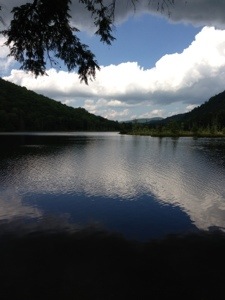
Splintered sunlight
Scattered raindrops
Under tree canopy
Ears attune to droplet music
Eyes on concentric circles
Mourning doves coo ceaselessly
Birds chirp intermittently
Loons paddle and dive past
Silent now
At night they laugh
Transient figure in Green Mountains
I, Sacajawea, swim to a rock outcropping.

20130729-122940.jpg

20130729-193249.jpg

The Door-to-Door Salesperson I invited to Dinner

Nothing can inspire fear like a door-to-door salesperson. In sensible people, that is. I want to know all about the religion, the organization, the person at my doorstep. This could get me into trouble. I have disappointed very sincere LDS (Mormon) missionaries.

After a while, it is not fair to let these people return in good faith that they have saved a soul or made a sale, so I have to let it go. I did go just a bit overboard the other day when I heard so much of the young magazine salespersons life story, fictional or not, that I had to invite him in to dinner. We were alone that evening, kids elsewhere, and this young man, from Youngstown, Ohio, about the age of one of our boys. We had discussed the Boys & Girls Clubs. We had discussed the GED and passing the five-paragraph essay by using an example to back up the topic sentences of the three body paragraphs. It was only later that I recalled that he kept mentioning foster homes. I asked him, not knowing his religion, whether he minded if I had a glass of wine with dinner and offered him water or milk. He asked for milk, please, and said his mother sometimes has a glass of wine with dinner.

Does he have a mother with whom he lived? Will this organization really improve his prospects for the future? I fail to see how anyone can afford to go to Paris, much less a bunch of city kids in a van. Was I helping or making things worse? I wish we had a bigger dinner that night, and was glad that we have rich and filling whole milk at home–no skim milk here. He said that he was looking forward to the Chinese food he would have when they got back to the hotel in Cherry Hill. It was 8pm, and I was hungry, so suggeated he eat with us first and with his group later. He was skinny enough.

Two things bother me most about this encounter, aside from not being able to have another conversation. When I asked about girls or young women in the program, he said that the grandmother of the only two girls had asked to have them dropped off at her place in Atlantic City, and they might rejoin the group in September. It struck me later that I wasn’t quite as dumb as I felt because it had taken Grandma a while to catch on, too. Either there is a really Good Samaritan from North Philly putting up kids, and helping them off the streets with haircuts and dress shirts, or there is someone taking advantage of inner-city kids.

The other thing that concerns me is lesser, but I do wish I had stuck with my instinct of saying I had no checks and paying cash. Somewhere a guy may be figuring out how to access our checking account. Any suggestions? Call the bank to alert for any large check or ACH withdrawal? It seems odd that the check has not been cashed. I certainly want no magazines, and most people loathe the conversation most of all. Business can’t be so good that there is no need to deposit checks. It’s not the young salesman I don’t trust; it is some force working behind the scenes, of which he may not be aware. If this Saint Philadelphia had not been starving the kids, I wouldn’t feel quite so suspicious.

The young man took the few remaining cherry tomatoes I had picked and set in a little bowl on the dinner table in hand as he left, saying how good they were. Jersey tomatoes are delicious, and maybe he was just being polite, since I am proud of my little garden. I digress a bit, but the garden is not doing terribly well. I currently mourn one summer squash plant that succumbed to the western exposure and near hundred-degree heat. We also lost our first, early pumpkin last night while it was still green. We suspect a squirrel attack night, so I am in mourning over that, too. The pumpkin plant is a volunteer, and the plant is too large and wild to be enclosed. How can I protect the next pumpkins as they grow?

Why do I have weak moments for door-to-door salespersons? I was once an Avon…girl. Lonely people let me in their homes, and told me their stories. An elderly lady ordered one tiny liostick to be sure that I would return. I wish I had returned many times, just to visit, and that we had become friends.

Not many years later I boldly ventured forth, a Realtor in a short, purple cap-sleeved square-necked dress with matching purple kitten heel pumps. Wearing this possibly unparalleled garb, I knocked on doors, and asked those who answered whether they would like to list their house with me. Even more amazing than the outfit is the fact that some said “yes,” and did so. I did a fine job, and graduated in short order to wearing skirt suits.

A few years after that, I sold all but one of the suits at a garage sale. It was time to stay home with baby and young child. The orange suit still hangs in the basement. The ocean blue and turquoise suits more appropriate for San Diego were sold within ten minutes. My best friend had an aquamarine one, the color of her eyes. Her mom took a picture of us wearing the aquamarine and orange suits, so that is the one that is emblematic of that phase of my life, and time spent with my dear friend, Ann. We didn’t always work and wear suits. We made time for fun, too. Realtors work on weekends, early in the morning, and late at night, so we sometimes took time off to meet and park at 19th Street in Del Mar for a short beach run. We took Thursdays off, and took the kids to a local park or to Sea World. After our excursions, her daughter would take a proper nap of two or three hours, and my energetic son would swing from the pantry doors.

So…that is why I don’t always pretend not to be home when young salespeople come around. People not only invited me into their homes, they trusted me with their life savings. More poignantly, the elderly lady trusted me enough to invite me in, and the teenage mother, who should have been in high school, or maybe even in middle school, trusted me to be in her parents home with her baby.

I will have to find and include the iconic California Realtor photo by the beach in Del Mar, or at least a picture of the suit or pumps. Should I share my trade secrets with those distributing various earnest literature? Looking less serious worked for me.

Disappointed in myself, I will call the bank tomorrow, and let them know the amount for which the check was written. I am normally pretty sensible and consult Charity Navigator before making any donation, but the occasional “random act of kindness” can’t hurt. Or can it? Is that young man stuck in a situation he can’t escape? Did I contribute to that situation, or is the dying business of magazine sales really a ticket to Paris? Have I unwisely jeopardized our son’s not-yet-begun college education by putting us at financial risk?

Yes, I am prone to “escalating thinking.” If I don’t make my very small donation to MSF orUNICEF polio will not be eradicated. It’s not that I am burdened by a sense of my own importance, and definitely not by wealth: My simple, firm belief is that everything everyone does matters all the time.

My Dry Bones will Rise

My dry bones will rise one day.
They will rise crying and complaing.
Not about all the wrong I done
When I was young.
They will cry out against the crushing pains,
Self-inflicted daily,
in adult life.

Go, children! Disregard all convention. Throw off repression.
They have: No encouragement required. Camp Bisco, soggy or not, here they come.

Never consider finance & education & self-worth simultaneously.
May you never pour over a 529 or a 401.

Pour yourself instead into ceramics, gardens, drawing, and music.
Delight in such delicate things as the native grass
with fine stalks & tiny
yellow-eyed blue flowers.
It grew up only because the hose bib leaks.

Learn to live from, and to respect, the earth again. Eat dandelion greens.

Love justice, but one another most of all. Walk neither humbly, nor with a puffed up sense of your own importance: there is no one more or less important than you.

Keep music in the center of your lives and souls. Keep embodied action–being in nature, recognizing the inimitable beauty of the perfect pass, stroke, dive, or block, executed in milliseconds, making love, & hugging friends–in the center, too.
Keep grades, diplomas, and all manner of achievement, in the periphery.

Should you become a parent, may your children be born in Canada or Europe. It will be safe to return when we stop making war, lay down the guns in our cities and towns, cease to uphold marriage as a divisive tax-benefit, and provide health care for all.

If it please you, communing with a loving, nonjudgmental God is fine, too. “In [God] there is no darkness at all.” Bless you, always, in the name, dirt, rivers, rocks, lakes, oceans & trees of Mother Earth and Jesus, our common names for all love, all-enveloping.

Disregard all advice. There is no authority higher than your own conscience.

–Circe, on the anniversary of her older son’s birth (apparently channeling Dr. Bronner.)

Eggs, Oranges & Avocados: Self-Contained

Today I packed lunch, dinner, or first dinner, to take with me to work in the afternoon and evening. Not sure which meal I truly packed, but since I am fortunate enough to have food, I attempt not to leave home without it. For the record, I am not overweight, except perhaps by a chart that believes I am still in high school.

As I packed, I ate the less conveniently portable items. Caprese salad made with our own basil. Right. Anyone can grow basil anywhere, but humor me. And since I use no pesticides, growing cherry tomatoes works best for this novice gardener. My self-esteem appreciates your indulgence. No, I did not raise or milk the buffalo that provided the fresh mozzarella. I am not a farmer, just a suburbanite wishing to be more self-sustaining, feeling trapped by forces growing her town into a city. By the way, I think Bill Clinton first used the word “growing” as a verb about expanding the economy. Will I start eating the garden bunnies? I do think that is the right thing for a carnivore to do. The consumption of factory-farmed animals should be avoided.

The items I packed in my lunch bag are self-contained foods: an egg, an orange, an avocado. My goal is to become an avocado. Well, the skin is a bit bumpy: cellulite problem, I guess, but such a gorgeous green color and irresistible. Most of all, elegantly self-contained, while I am all over the place.

Guacamole is also delicious, so maybe I just need to accept the fact that I will blather on, discuss religion, politics, legalization of marijuana, gun control, and the human control of youth called high school as well as incarceration.

No, I am clearly not running for Ms. Mom NJ! I do not want to be a preschool teacher. I wish I did! They must be the most universally beloved of people and especially teachers. Preschool is not yet about containment.

Avocados and eggs don’t have much to do with big news–the military coup foremost in the news–but they are important. The less packaging, whether Styrofoam, plastic, or plastic wrap, and the less cancer-causing, landfill-destined packaging used, the better.

To return to the avocado: it doesn’t know it has cellulite. I neither complain nor reveal, but believe me: I am a hypocrite. If my skin goes all orange-and-avocado peel on me, I won’t do anything drastic: no thanks to knife or suction! But I will probably spend some money on anti-cellulite lotion: Money better spent on something worthy, and social-justice oriented than my epidermis. Socialization is insidious and powerful.

From what I read, I surmise that the SES of most bloggers, aside from you who are in high school or college, is high. Does WordPress provide SES stats?

May Circe please charm you into thinking about these issues and commenting? Do you need to be or feel cellulite-free to be loved?

My best guess, not interviewing on the ground, is that people in Syria and Egypt are currently unconcerned about cellulite. Nor am I. I have many other trivial concerns. And some serious ones as well.

20130704-000636.jpg

Whistle a Happy Tune

Do you still whistle? I just tried a Swedish song about whistling & failed. Any fellow Swedes probably know the folk song “Kan du vissla Johanna?” The interlocutor asks Johanna if she can whistle, to which she replies that she certainly can, and then trills away.

So I tried to sing and whistle the song. The singing part went well, but as for the whistling…clearly I need practice! It may have been ten or more years since I whistled last. The first try was just whispery nothings. On the second I hit a few notes. On the third a few more, but the result was still unremarkable at best.

My younger son–not the one who sings so beautifully that friends ask why he is “wasting his time” in law school–has whistled from a young age. He doesn’t reply to many of my random texts, but when I texted “Do you still whistle?”, he immediately texted back that he loves to whistle and does so every day.

When I had my “OMG, I don’t remember how to whistle!” moment, their father, standing right there, whistled a clear and sweet tune. He claims to do so often. Sorry, husbands of the world: mothers of the world are more closely attuned to their sons. But in this case I had failed to tune in to simple joys provided by father or son.

One of my favorite moments of the year is spotting my first firefly. When I excitedly report this, I am inevitably met with “Oh, I saw one a week ago.” This does nothing to dampen my enthusiasm for fireflies.

Mosquitos or not, ninety degrees and humid or not, I insist on dining al fresco. During that time not only fireflies, but also bats flit about, sometimes audibly squeaking. I wonder where they sleep during the day. We make sure to leave the clover patches intact to attract the bunny-of-the-evening. One day a larger bunny may stop, sniff, and nibble, quite confidently, barely out of reach. The next evening the bunny may be smaller, and more skittish, as young creatures are. All of this is my version of “taking time to smell the roses,” a gift my father had cultivated well, and attempted to instill in me as a child.

Why was I particularly attuned to the fleeting gifts around me yesterday? First I brought some lettuce, a whole freshly picked bag full, straight from my garden to my mother, brother, sister-in-law, and niece who had all converged just around the corner. Many of the Golden Globe cherry tomatoes will be ripe by the end of the day today, but there was only ripe yesterday, so it was for mom, naturally. They were all impressed, as though I had performed a great miracle. It is nothing, I thought. But really, it is the product of several years work. First building the garden boxes, then amending the soil, then planting and tending, shading and watering. Watering was crucial when the seedlings first sprouted. hand-watered them then, to conserve water. Now when there has been intense heat and no rain for a few days, I water early in the morning before the sun’s rays hit the leaves of sunflowers, tomatoes, summer squash, pepper plants, carrot tops, herbs, and lettuce. If we did not live on a busy corner at which every large truck or van speeds by, or worse yet, makes a u-turn, and the background noise was only birds, not construction and traffic and the annoying hum of weed whackers, this would be truly idyllic.

But life remains imperfect. Yesterday I learned over and over again of acquaintances, family friends, teachers and students–most in middle years, full of responsibilities for children, spouses, and work–who were struggling with, or have succumbed to the contemporary plague of cancer. The news was so overwhelming that the best response seemed to be that of the victims themselves, to enjoy the day as I was able.

I may whistle a mournful tune as well when I have recaptured the ability, but for now, I am going to work on once again learning how to whistle a happy tune.

Graduation Day! Mixed Emotions

20130620-085819.jpg

Today is graduation day for the high school students in our district. Some years ago, Michelle Campbell (2007) wrote an article about the students who didn’t graduate, and were held back for summer school or worse yet, another year. Not surprisingly, most of these students were African-American men. My young man upstairs is a bit of an iconoclast, and gave us some (a lot!) of worry about whether he really would graduate. He is a stubborn one, and he is done: it would either be high school
diploma today or GED another day. Nothing, neither powers, nor principalities, nor parents would convince this independent-minded young man to attend summer school. My daughter nailed it when she said that the phrase “summer school” is an oxymoron.
From one end of the spectrum to the other: Some children attend summer school at local private schools, taking classes (presumably not PE) they will take the following year. Why do they do this? To be sure they will get As and into the right college. The culture of overachievement is just as depressing as the culture of underachievement. What kind of childhood is that?!
The boy (technically a man now, at 18) asleep upstairs spent part of his summers running around barefoot in Vermont at a camp that allowed no access to cell phones or computers. Meanwhile, these super-achievers spent their summers in classrooms staring at computer screens or enrolled in Kaplan or Princeton Review classes.
Our school system is singularly ill-equipped for the “average” student. This boy is far above average intelligence, but has adopted a fairly strict policy of not studying for exams or doing much homework. (Calculus was the exception to that rule.) He is not in it to prove a thing to anybody except, perhaps, that he won’t be programmed, scared, threatened or bribed into thinking that straight As and an Ivy League education are the path to happiness in life.
Many of the classes at our College Town, NJ high school are only offered at the accelerated or AP level. AP classes have proven to be little better than the Kaplan courses my sons refused to take for personal and political reasons. The exception to this was both sons’ wonderful experience in environmental science. This class includes field trips and a highly intelligent, disorganized, Canadian science teacher. I confess to never personally noticing that Mr. Anderson is disorganized and his classroom messy. This I was told by others. Shouldn’t a science classroom be full of interesting, touchable things? What I do know is that the ten minutes in Mr. A’s classroom at back-to-school night did not make me want to fall asleep or weep for the poor children in his class. I’m sorry I never took the class myself. There was only “earth science” when I was in high school, and that, sadly, meant that you were on the “slow” unacademic track, heaven forbid! So however interesting that class may have been, my friends and I never found out.
This is not a call for schools to cater to the “average” in the sense of lowering their standards, but to become more engaging, and get the kids out from behind their desks as often as possible.
The literary curriculum makes the skin of this former English major–who took accelerated English with an engaging curriculum & teachers–crawl. Please revise! Why on earth should my son, or any other high school student, read The Girl with the Pearl Earring? It is a fine book for book group or a light summer read, but offers nothing more. Did the local school board or state select this light novel because it is uncontroversial in content? I am appalled. This is but one example of a curriculum from middle school on, which has been gender inequitable, forcing books far more likely to appeal to young women than young men. I loved Jane Eyre, but my son refused to read it. He would not even stoop to read the Spark Notes or Wiki summary. Both his male guidance counselor and his male teacher agreed that they, too, would not read Jane Eyre for love or money. My son reads books on his own, as we all do in this family, independently and for interest. He goes to the place known as the “media center” to borrow books. Why not provide an option more likely to appeal to young men?
College will bring some of the same challenges, but more choices. A major in agriculture will certainly involve writing research papers, and writing up labs, but also, literally, time in the field.
God Speed, my idealistic and stubborn young son. I will miss you terribly and daily. Tears fall as I write. There will be no one around to drink a quart of milk and eat a daily box of cereal. The soccer field has already been rejected in favor of hiking and backpacking–outdoor adventure–but the tiny mudroom is littered with keeper paraphernalia and soccer cleats. I don’t think I will put them away any time soon. The saxophone, keyboard, and drum set are somehow crowded along with camping gear into a small and extremely messy room. Part of me itches to crawl under that bed and dig out some mysterious items, but mostly, I will miss him. But it is time. The University of Vermont, agriculture, environmental science, and ceramics await. This is not to mention friends, hiking, backpacking, skiing, and possibly club soccer. Fare thee well, my boy, my young son.

20130620-082646.jpg